
FDA medical device classification: find your device class, product code and pathway
FDA medical device classification decides how your device reaches the US market. We identify your product code, regulation number and device class, check exemptions and special controls, and tell you exactly which FDA pathway applies — 510(k), De Novo, PMA or registration only.
How FDA medical device classification works
The US FDA places every medical device into one of three classes based on the risk it poses to the patient and user. Class I is the lowest risk, Class II is moderate risk and Class III is the highest risk.
The class is driven by the device's intended use and indications for use, plus factors such as where it is used in the body, how long it is in contact with the patient, and whether it is active, powered or implantable.
Your FDA device class decides your pathway
Classification regulations are set out in 21 CFR Parts 862–892, where each generic device type has a regulation number, a three-letter product code and a review panel.
The class sets the regulatory controls you must meet and your premarket route: registration and listing only, a 510(k), a De Novo request or a full PMA. Getting it wrong can mean a refused submission and months of delay.
Who needs an FDA device classification check?
Anyone placing a medical device or IVD on the US market should confirm its class before planning testing, design controls or a submission.
How to find your FDA medical device classification, step by step
- 1
Define intended use
Step 1Write a clear intended use and indications for use statement. It drives every classification decision that follows.
- 2
Search the FDA classification database
Step 2Search the FDA Product Classification database by device name, keyword or product code to find matching generic device types.
- 3
Identify regulation, product code and class
Step 3Confirm the 21 CFR regulation number, three-letter product code, review panel and device class that fit your device.
- 4
Check exemptions and limitations
Step 4Many Class I and some Class II devices are 510(k)-exempt, but only within the limitations set out in the regulation.
- 5
Review special controls and standards
Step 5Identify special controls, FDA guidance documents and recognized consensus standards that apply to your device type.
- 6
Resolve uncertainty with a 513(g)
If neededIf no regulation clearly fits, submit a 513(g) Request for Information to get FDA's view on class and requirements.
- 7
Choose the regulatory pathway
OutcomeProceed to registration and listing, a 510(k), a De Novo request or a PMA, with a plan for testing and timelines.
FDA Class I, Class II and Class III explained
Each FDA medical device classification comes with its own level of control. The higher the risk, the more evidence FDA expects before the device can be marketed.
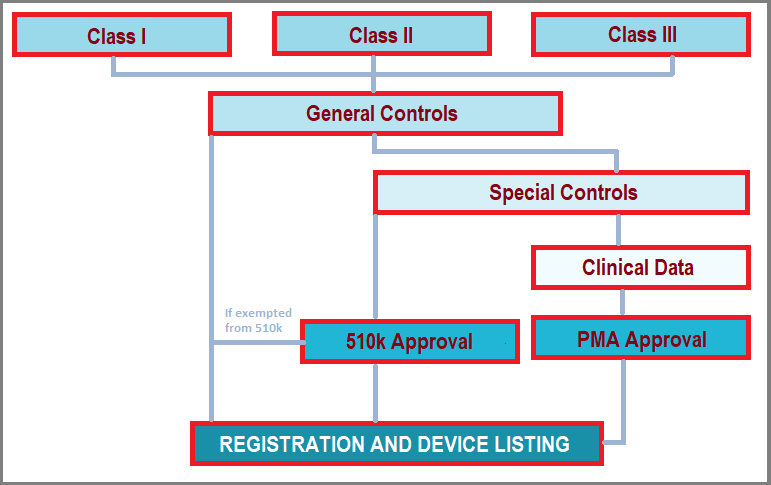
For FDA's own overview, see Classify Your Medical Device.
FDA Class I, II and III medical devices compared
Each class carries its own controls and premarket requirements. Use this as a quick reference; the exact rules come from your device's classification regulation.
| Class I | Class II | Class III | |
|---|---|---|---|
| Risk level | Lowest | Moderate | Highest |
| Potential harm | Minimal potential for harm | Higher risk than Class I devices | Supports or sustains life, is implanted, or presents a potential unreasonable risk of illness or injury |
| Regulatory controls | General controls | General + special controls | General controls + premarket approval |
| Typical submission | Mostly 510(k)-exempt; some need a 510(k) | 510(k) (some exempt); De Novo if no predicate | PMA (a few preamendment types via 510(k)) |
| Clinical data | Rarely required | Sometimes required | Usually required |
| Examples | Elastic bandages, examination gloves, hand-held surgical instruments | Powered wheelchairs, infusion pumps, surgical drapes | Implantable pacemakers, heart valves, breast implants |
Our FDA medical device classification services
FDA medical device classification FAQs
How do I find the FDA medical device classification of my device?
Search FDA's Product Classification database using your device name or a similar device. The matching entry shows the regulation number, product code, device class, review panel and whether the device is 510(k)-exempt.
What is an FDA product code?
A three-letter code FDA assigns to each generic device type. It links your device to its classification regulation and is used for registration, listing and premarket submissions.
Do Class I devices need a 510(k)?
Most Class I devices are exempt from 510(k), but some are not, and exemptions only apply within the limitations in the regulation. Exempt devices still need establishment registration, device listing and general controls.
What if my device doesn't fit any classification regulation?
A new device type with no predicate is automatically Class III. If it is low-to-moderate risk, a De Novo request can classify it into Class I or II. A 513(g) request can confirm FDA's view first.
What is a 513(g) Request for Information?
A formal request asking FDA how it would classify your device and which requirements apply. A user fee applies, and FDA aims to respond within 60 days.
Can a device's classification change?
Yes. FDA can reclassify a device type, and changes to your intended use or technology can move your device into a different classification or pathway.
Not sure of your FDA device class?
Send us your intended use using the form below. We'll confirm your FDA medical device classification and pathway at no cost.